
Weave In, Weave Out: Process as Practice
By Lin Qiqing
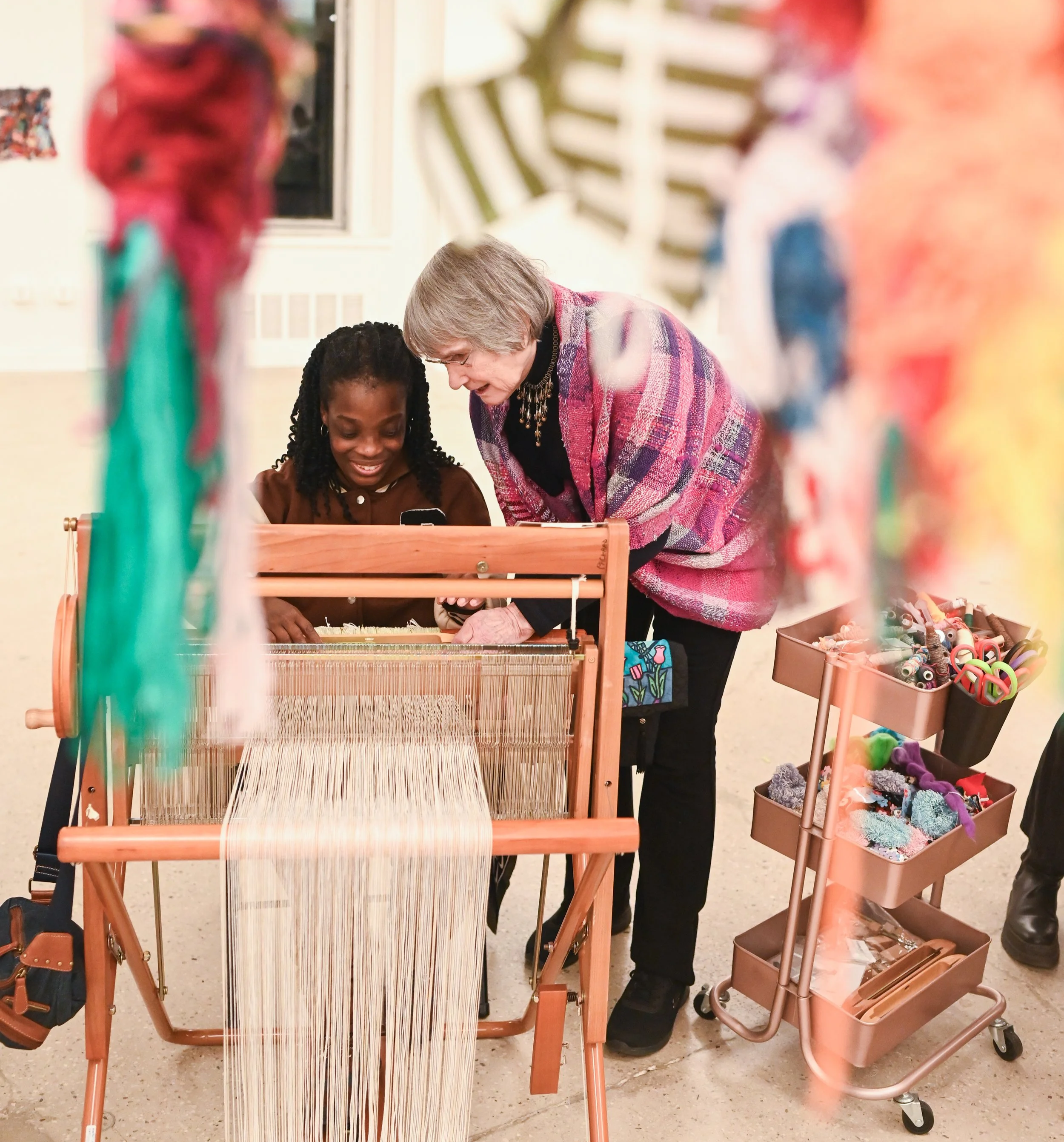
Weave In, Weave Out Opening, January 23, 2026, Photograph by Alison Graham of Positive Exposure, Courtesy of Intertwine Arts.
Six floor looms face inward to form a circle. Above them, long strips of woven fabric hang like a soft chandelier, creating a space where conversation happens naturally. Visitors are invited to sit down and weave, making pieces that they can either take home or add to a growing display wall as part of the exhibition.
This exhibition Weave In, Weave Out takes place at Positive Exposure Gallery in New York City’s Financial District from January 23 to March 22, 2026. Organized by Intertwine Arts, a non-profit organization that offers fiber art workshops for people with disabilities, the show includes weaving, embroidery, soft sculpture, and installation made by 30 contemporary disabled artists.
As the title suggests, visitors are welcome to enter, exit, linger, and return to the looms. The gallery operates as a living social sculpture. Free and open to the public, the exhibition invites visitors to weave with support from Intertwine Arts teaching artists, with all materials provided. Over the two-month run of the exhibition, hundreds of visitors are expected through scheduled sessions with partner organizations, as well as independent drop-ins who can book up to two-hour weaving sessions through Intertwine Arts’ website.
“We wanted people to come and experience for themselves the joy of the weaving process and to let the audience become part of the exhibition,” said Anna-Maie Southern, creative director of Intertwine Arts and co-curator of the show. The idea, she explained, is that the process of weaving and coming together as a community, is the art, rather than focusing on the finished product.
Collective making has long been embedded in textile traditions. The exhibition shifts emphasis away from polished works or technical skills, highlighting weaving as a medium where relationships, trust and care grow in a community setting.
Founded in 2015 by a group of textile artists and health practitioners, Intertwine Arts provides programs for people with intellectual or physical disabilities, to inspire creativity, joy, and self-confidence through free-form weaving. Teaching artists travel to partner organizations across New York City, offering weekly workshops in weaving, embroidery, sewing, and other fiber art projects.
The exhibition marks a milestone reflecting more than a decade of programming. At its center stands a tent installation covered with hand-woven fabrics produced across Intertwine Arts workshops over the past ten years. Titled The Threads That Intertwine Us, the installation gathers yardage of woven fabrics of different colors and textures made by many hands. The accumulation of fabric becomes a visual record, representing the community of artists from diverse backgrounds with a shared passion towards textile art.
Inside the tent sit handmade stuffed animals and dolls, including Dumbo and Winnie-the-Pooh, created by artists with visual disabilities by sewing circular weavings made using tools as simple as paper plates. Labels in Braille accompany works throughout the gallery, and audio descriptions are available on the exhibition website, underscoring accessibility as a core principle of the exhibition.
“Weave In, Weave Out speaks to the social and political conditions of the present moment,” writes co-curator Amanda Cachia, a specialist in disability arts activism. “In an era marked by global instability, austerity politics, and the erosion of social safety nets, disabled communities are often among the most impacted.” By centering disabled artists and accessible making, the exhibition positions weaving as a form of everyday resistance, asserting disability not as a site of lack but as a generative force.
As a teaching artist who has worked with Intertwine Arts for over three years, I was happy to see the exhibition take shape. With many compelling works on view and an emphasis on the making process, the show demonstrates the inclusivity of fiber art and its capacity to engage diverse makers and audiences, interlacing textile art with social practice.
Lin Qiqing is a textile artist based in New York City.